Suspended floors
Useful where there is a subfloor. A good deal of Hobart's oldest housing does not have one.
Where a house has a suspended timber floor over a void, that void needs to breathe. Damp ground under a poorly ventilated subfloor raises the humidity in the cavity, and the bearers, joists and the underside of the floorboards take it up. Rising Damp Hobart checks subfloors alongside the walls, because on the houses that have one it is often the cheaper half of the problem.
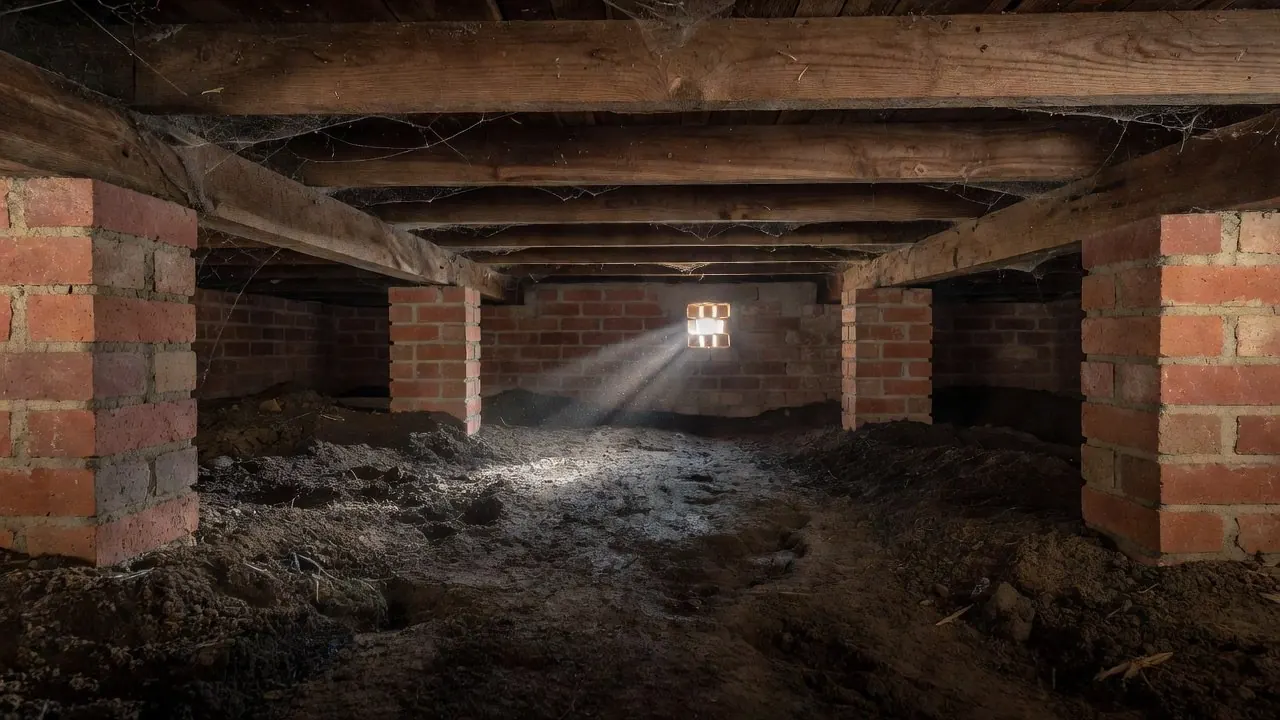
Garden beds, paths and later paving covering airbricks that were adequate when the house was built. A cause to check first, and usually the cheapest to correct.
Older houses were built to a lower standard than current practice, and an extension or an enclosed verandah often blocks the cross-flow that made the original count workable.
On a sloping Hobart block, water running down the hill can enter the subfloor from the uphill side and sit there. Ventilation alone will not fix standing water; the drainage has to come first.
Building rubble and boxes left under the floor block airflow and hold moisture against the timbers.
Much of Battery Point, central Hobart and older New Town is solid masonry sitting directly on the ground, with a solid floor and no void at all. Subfloor ventilation is meaningless on those houses, and a contractor proposing it without having established that a subfloor exists has not looked properly. Similarly, on a concrete-slab home the answer to a damp wall is never a vent.
Indicative range is $900 to $3,500 depending on whether passive vents are sufficient or powered extraction is needed, and how difficult access is. It reduces humidity in the void and protects the timber. On its own it does not stop water rising through a masonry wall — that is a different mechanism and needs a different fix, and the two can be sold together when only one is warranted.
We cover Hobart and the surrounding suburbs, from the Georgian cottages of Battery Point to the post-war brick of Glenorchy and Moonah.
We come out, meter the walls, look at the ground levels and tell you what is causing it. You get that in writing before we quote any repair. The visit is $450 plus GST.