The mechanism
Groundwater moving upward through masonry, against gravity, because the material behaves like a wick.
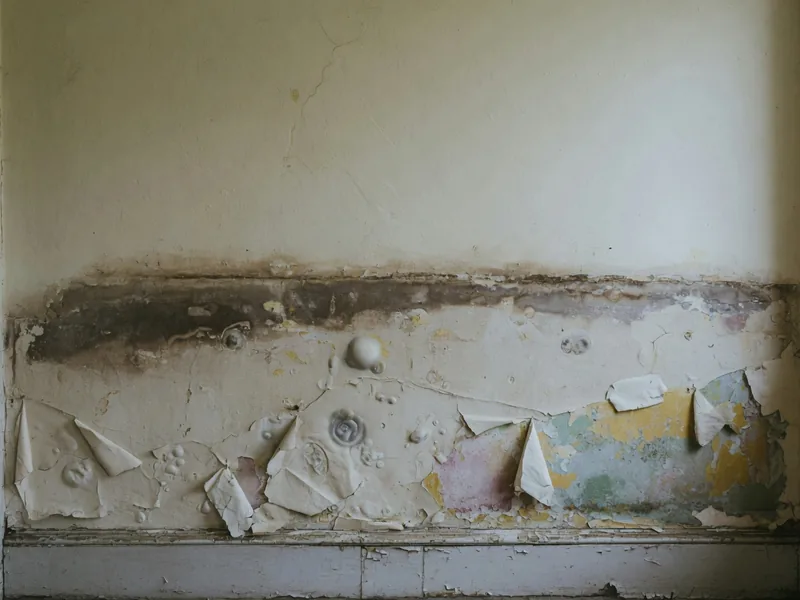
Every masonry wall sits in contact with the ground. Brick, sandstone, lime mortar and rubble footings are all porous — they are full of tiny interconnected channels. Water in the soil is drawn into those channels by capillary action and travels upward until the rate it evaporates from the wall face matches the rate it is being pulled up. That balance point is why rising damp has a ceiling, usually somewhere under a metre and a bit, and it is the single most useful thing to know when you are trying to work out what you are looking at. Rising Damp Hobart carries out the assessment that establishes it.
A damp proof course: a continuous impermeable layer built into the wall near the base, which the water cannot cross. Modern Australian construction has used one for a long time. Much of Hobart's housing predates it entirely.
Georgian and early Victorian solid masonry, roughly the 1830s to the 1860s. Sandstone or brick on rubble or slate footings. Nothing was ever built in to stop the water, so the wall has been wicking since it was put up. Battery Point, central Hobart and the older parts of New Town.
Later Victorian and Federation houses often had one — slate, bitumen felt, sometimes lead. Slate cracks when a building settles. Felt becomes brittle and breaks down. A course that worked for eighty years can stop working entirely.
A cause to rule out first in twentieth-century housing, and the cheapest to fix. Someone built a path around the course: a concrete path poured against the wall, render carried down past it, a garden bed heaped up, a new driveway level. The course is intact and the water simply goes around it.
Rising damp is a balance between water arriving and water leaving. Anything that slows evaporation raises the tide mark and keeps the wall wetter. Hobart's winter does exactly that — high humidity means the air is already close to saturated and will not take much more, and there is very little sun to warm the wall face. South-facing and shaded walls, which in a South Hobart or Battery Point street can mean most of the house, are the slowest of all to dry.
Two things are often mistaken for it. Condensation forms on cold surfaces from moist indoor air — it turns up in corners, high on walls, around windows and behind furniture, and it has no tide mark. Lateral damp comes through a wall horizontally where the ground outside is higher than the floor inside, which can happen on any of Hobart's sloping blocks. Lateral damp can appear at any height on the affected wall and often only on the uphill side of the house. Treating one as the other wastes money, which is why the wall gets metered before anything is quoted.
We cover Hobart and the surrounding suburbs, from the Georgian cottages of Battery Point to the post-war brick of Glenorchy and Moonah.
We come out, meter the walls, look at the ground levels and tell you what is causing it. You get that in writing before we quote any repair. The visit is $450 plus GST.