New Town, TAS
New Town: Georgian through Victorian housing.
The main housing in New Town is 1840s–1900s, mixed Georgian through Victorian, and Rising Damp Hobart meters those walls before we price any repair.
New Town has some of the oldest housing outside Battery Point, mixed in among much later infill. Two houses on the same street can be seventy years apart and need completely different treatment. On the older solid-masonry places with no damp course, water in the ground means slow, steady uptake through the base of the wall all winter. Where a later brick wall sits on an original sandstone footing, that is worth identifying early, because the two materials behave differently.
| Main housing | 1840s–1900s, mixed Georgian through Victorian |
|---|---|
| Height above sea level | about 42 m |
| Height range within 250 m | about 23–49 m |
| Derwent estuary shore (salt water) | about 1.2 km away (straight line) |
| Centre of Hobart | about 3.2 km away (straight line) |
| Main roads near the centre | New Town Road, Augusta Road, Argyle Street and Park Street |
| Named parks nearby | John Kennedy Reserve, Swanston Street Playground and Garrington Park |
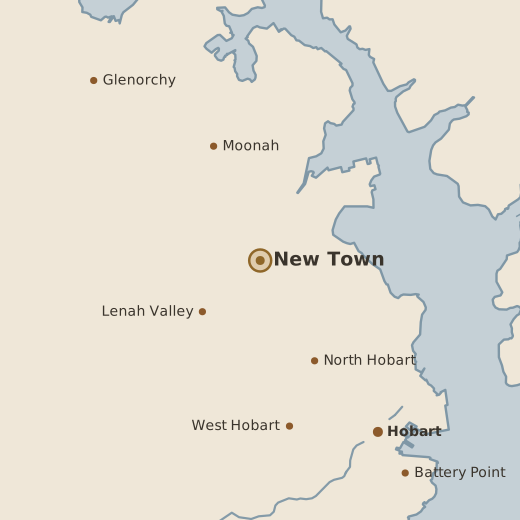
New Town is 1.2 km from the estuary shore and 3.2 km from the city. That puts it between the waterfront suburbs and Lenah Valley (2.3 km). Here the distances matter less than the date of the house, because the date says whether the wall has a course at all.
Prices are on the cost page and the measuring method is on the about page. Nearby: Lenah Valley, North Hobart, Moonah, West Hobart.
We cover Hobart and the surrounding suburbs, from the Georgian cottages of Battery Point to the post-war brick of Glenorchy and Moonah.
We come out, meter the walls, look at the ground levels and tell you what is causing it. You get that in writing before we quote any repair. The visit is $450 plus GST.