North Hobart, TAS
North Hobart: terraces built tight to a raised footpath.
The main housing in North Hobart is 1890s–1920s Victorian terraces and workers' cottages, and Rising Damp Hobart meters those walls before we price any repair.
North Hobart's terraces and workers' cottages sit tight to the street. There is very little setback, so the footpath and the front wall can be at nearly the same level. That is the first thing to check here. A footpath resurfaced once or twice over a century can creep up until it sits above the floor inside. The front room then stays damp no matter what is done indoors. Terraces add a second issue. You share a party wall, so a neighbour's ground levels and drainage can cause damp on your side of it. Fixing that is a conversation with two households.
| Main housing | 1890s–1920s Victorian terraces and workers' cottages |
|---|---|
| Height above sea level | about 50 m |
| Height range within 250 m | about 39–78 m |
| Derwent estuary shore (salt water) | about 1.5 km away (straight line) |
| Centre of Hobart | about 1.5 km away (straight line) |
| Main roads near the centre | Burnett Street, Argyle Street, Elizabeth Street and Murray Street |
| Named parks nearby | Soundy Park and North Hobart Cultural Park |
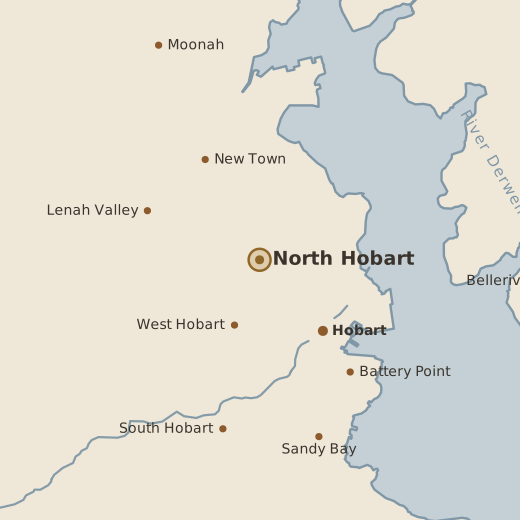
North Hobart is 1.5 km from the estuary shore, so wind-borne salt is a smaller factor than at Battery Point or Sandy Bay. For a terrace built to the footpath, the measurement that matters is the footpath against the floor inside. That is taken at the house, not from a map.
Prices are on the cost page and the measuring method is on the about page. Nearby: West Hobart, New Town, Lenah Valley, Battery Point.
We cover Hobart and the surrounding suburbs, from the Georgian cottages of Battery Point to the post-war brick of Glenorchy and Moonah.
We come out, meter the walls, look at the ground levels and tell you what is causing it. You get that in writing before we quote any repair. The visit is $450 plus GST.