Moonah, TAS
Moonah: workers' cottages on tight blocks.
The main housing in Moonah is 1920s–1960s workers' housing, and Rising Damp Hobart meters those walls before we price any repair.
Moonah's inter-war and post-war workers' cottages sit on small blocks, close to one another. That can limit how much is possible outside the wall. Where there is not enough room to regrade or install drainage without a neighbour's agreement, the fix goes back to the wall itself: an injected course plus salt-resistant replastering. A masonry chimney breast is worth metering on its own, because a stack with no fire in it no longer gets dried from inside.
| Main housing | 1920s–1960s workers' housing |
|---|---|
| Height above sea level | about 19 m |
| Height range within 250 m | about 14–28 m |
| Derwent estuary shore (salt water) | about 1.1 km away (straight line) |
| Centre of Hobart | about 5.1 km away (straight line) |
| Main roads near the centre | Main Road, Albert Road, Hopkins Street and Central Avenue |
| Named parks nearby | St Aubyn Square Reserve, Benjafield Park and Station Street Park |
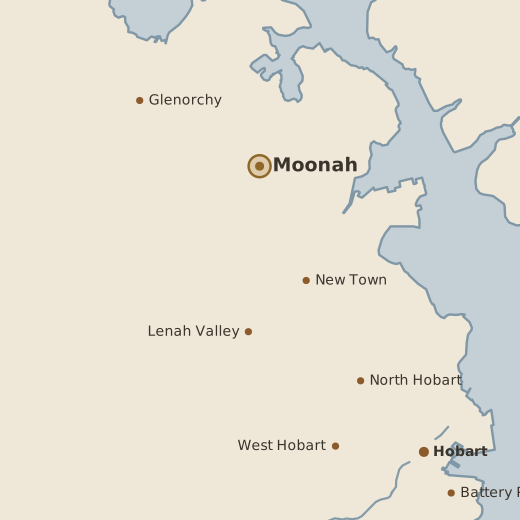
Moonah's centre is 1.1 km from the Derwent shore and 5.1 km from the city. Wind-borne salt is less likely to reach walls at that distance than at Battery Point (0.3 km) or Bellerive (0.2 km). So salt in Moonah plaster points first to water coming up from the ground.
Prices are on the cost page and the measuring method is on the about page. Nearby: New Town, Glenorchy, Lenah Valley, North Hobart.
We cover Hobart and the surrounding suburbs, from the Georgian cottages of Battery Point to the post-war brick of Glenorchy and Moonah.
We come out, meter the walls, look at the ground levels and tell you what is causing it. You get that in writing before we quote any repair. The visit is $450 plus GST.