Bellerive, TAS
Bellerive: Victorian village core and post-war behind.
The main housing in Bellerive is 1880s–1950s, Victorian near the village and post-war behind, and Rising Damp Hobart meters those walls before we price any repair.
Bellerive splits into two problems. The older village core near the bluff has Victorian brick and stone, where an early course may have failed or been bridged. Behind it, the post-war brick is more likely to have been built with a course, so condensation is worth ruling out there too. Readings at several heights tell the two apart.
| Main housing | 1880s–1950s, Victorian near the village and post-war behind |
|---|---|
| Height above sea level | about 8 m |
| Height range within 250 m | about 8–21 m (6 of 8 points; 2 fall on water and are left out) |
| Derwent estuary shore (salt water) | about 0.2 km away (straight line) |
| Centre of Hobart | about 3.4 km away (straight line) |
| Main roads near the centre | Cambridge Road, Clarence Street and Gordons Hill Road |
| Named parks nearby | Stanley Park |
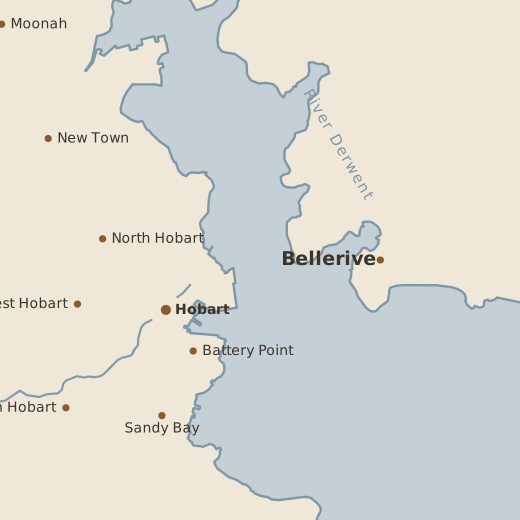
Bellerive's centre is 0.2 km from the estuary shore, the closest to salt water of any suburb with its own page on this site. Two of the eight measurement points 250 m out fall on the water. For the older brick and stone near the bluff, wind-borne salt is part of the picture. Salt-resistant replastering is then more likely to be needed alongside any course.
Prices are on the cost page and the measuring method is on the about page. Nearest pages, all across the Derwent: Battery Point, Sandy Bay, North Hobart, West Hobart.
We cover Hobart and the surrounding suburbs, from the Georgian cottages of Battery Point to the post-war brick of Glenorchy and Moonah.
We come out, meter the walls, look at the ground levels and tell you what is causing it. You get that in writing before we quote any repair. The visit is $450 plus GST.