Lenah Valley, TAS
Lenah Valley: inter-war brick, check for a bridged course.
The main housing in Lenah Valley is 1920s–1960s brick and weatherboard, and Rising Damp Hobart meters those walls before we price any repair.
Lenah Valley is largely inter-war and post-war, so a house here is more likely to have been built with a damp course. Then the first thing to rule out is a bridge rather than an absence. A concrete path poured against the wall. A carport slab. A later render coat carried down over the course. A garden bed built up against the brickwork. If it is a bridge, that is good news. Correcting the level or cutting the render back can cost far less than injecting a new course. It is worth having someone confirm which of the two you have before you accept a quote for the expensive one.
| Main housing | 1920s–1960s brick and weatherboard |
|---|---|
| Height above sea level | about 91 m |
| Height range within 250 m | about 67–106 m |
| Derwent estuary shore (salt water) | about 2.3 km away (straight line) |
| Centre of Hobart | about 3.3 km away (straight line) |
| Main roads near the centre | Augusta Road, Lenah Valley Road, Giblin Street and Montagu Street |
| Named parks nearby | Haldane Reserve, Glenrose Park and Ancanthe Park |
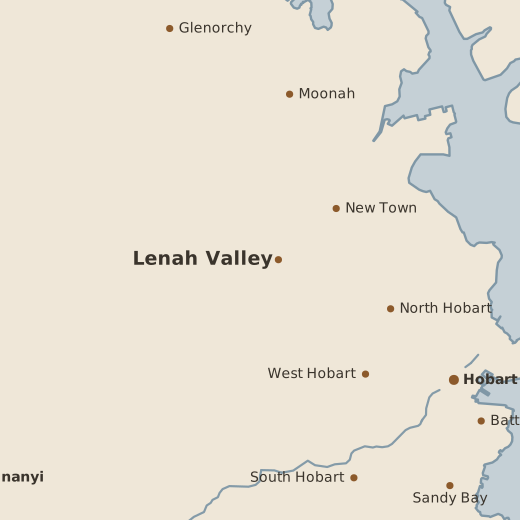
Lenah Valley is 2.3 km from the estuary shore, the farthest from salt water of the suburbs with their own page on this site. Wind-borne salt is a minor factor at that distance. If plaster here is salt-stained, the salt most likely came up from the ground. That points back to a bridged or failed course, not to the weather.
Prices are on the cost page and the measuring method is on the about page. Nearby: New Town, North Hobart, West Hobart, Moonah.
We cover Hobart and the surrounding suburbs, from the Georgian cottages of Battery Point to the post-war brick of Glenorchy and Moonah.
We come out, meter the walls, look at the ground levels and tell you what is causing it. You get that in writing before we quote any repair. The visit is $450 plus GST.