Prices
Indicative ranges, what moves them, and an honest note about what we cannot tell you from a website.
Rising Damp Hobart publishes ranges so you can budget before we visit. They are ranges rather than prices because the same job on a rendered brick cottage in Moonah and a sandstone wall in Battery Point are genuinely different pieces of work.
| Work | Indicative range | What moves it |
|---|---|---|
| On-site assessment and written diagnosis | $450 plus GST | Up to two hours on site. Moisture readings taken at intervals up each affected wall, an external check of ground levels, paving and downpipes, and a written diagnosis naming the cause. Every price below is quoted only after that visit. |
| Chemical DPC injection | $220 – $450 per linear metre | Per metre of wall treated. Sandstone and rubble walls sit at the top of the range because they drink more resin and take longer to drill. |
| Rendering and salt-resistant replastering | $90 – $180 per square metre | Contaminated plaster has to come off and be replaced, or the salt simply comes back through the new finish. |
| Lateral damp treatment (tanking a below-ground wall) | $350 – $700 per square metre | For walls with ground on the other side, such as a house cut into a slope. |
| Ground level and drainage correction | $1,500 – $6,000 | Often the cheapest real fix. If soil or paving sits above the floor level inside, no injected course will save the wall. |
| Sandstone repointing and stone repair | $180 – $400 per square metre | Lime mortar, not cement. Cement pointing traps moisture in the stone and accelerates the fretting it was meant to stop. |
| Subfloor ventilation, where there is a subfloor | $900 – $3,500 | Applies to the suspended-floor stock. Much of Hobart's oldest housing sits directly on the ground and cannot be ventilated this way. |
Prices are indicative ranges only. Every fixed price follows an on-site assessment.
How these figures were set: the $450 plus GST assessment is the one fixed price, set on 8 September 2026. The treatment ranges were entered when the site was built in August 2026 and have not yet been checked against written Hobart quotes, so treat them as a budget guide only.
The on-site assessment and written diagnosis is $450 plus GST. That is the one fixed price on this page. Everything else depends on the wall, so it is quoted only after we have seen it. Nobody can give you a fixed treatment price from a website.
A wall you can reach from both sides is a fraction of the cost of one you cannot. Terraces in North Hobart, party walls, and cottages built to the boundary all add labour before any material is used.
Sandstone and rubble take more resin and more drilling time than a solid brick wall of the same length. Rubble in particular has voids that swallow material unpredictably.
Salt-contaminated plaster cannot be painted over or sealed. If it has to be removed and replaced with a salt-resistant render, that can be a bigger line than the damp proof course itself.
A registered property needs Heritage Council approval for the works, which takes time and may rule out the cheapest method. Worth establishing at the assessment, not after a quote is accepted.
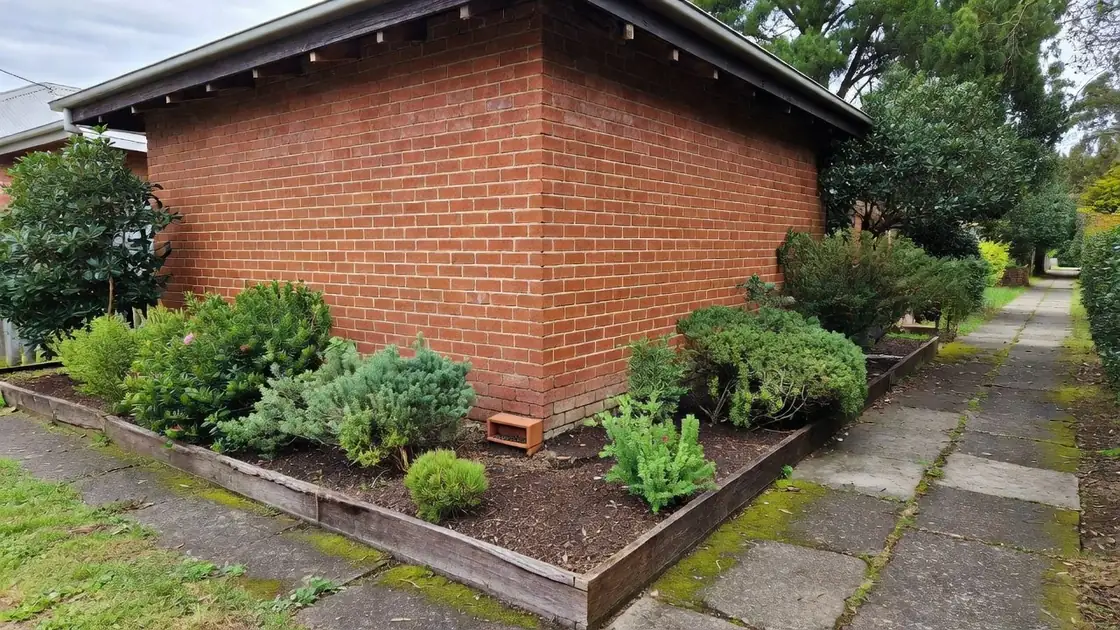
If soil, paving or a path sits above the internal floor level, water has a route into the wall that no injected course will block. Correcting the ground level or cutting a render coat back above the course can solve the whole problem. The table puts ground and drainage work at $1,500 to $6,000 for the job. Injection is $220 to $450 a metre, before any replastering. On a long wall the ground fix can be the smaller bill. So any assessment worth having checks the ground first.
Because the two things that drive the cost — how much wall, and what it is made of — cannot be seen from here. The range tells you the order of magnitude so you can decide whether to proceed to a fixed quote.
$450 plus GST. That covers up to two hours on site and a written diagnosis. Treatment is quoted separately, after the cause is known.
It is not an extra charge. The written diagnosis is part of the $450 plus GST assessment. You get the finding in writing even if the answer is that you do not have rising damp.
We cover Hobart and the surrounding suburbs, from the Georgian cottages of Battery Point to the post-war brick of Glenorchy and Moonah.
We come out, meter the walls, look at the ground levels and tell you what is causing it. You get that in writing before we quote any repair. The visit is $450 plus GST.