The Hobart complication
Water coming through a wall sideways, not up it. It affects houses cut into a slope, and it is easy to mistake for rising damp.
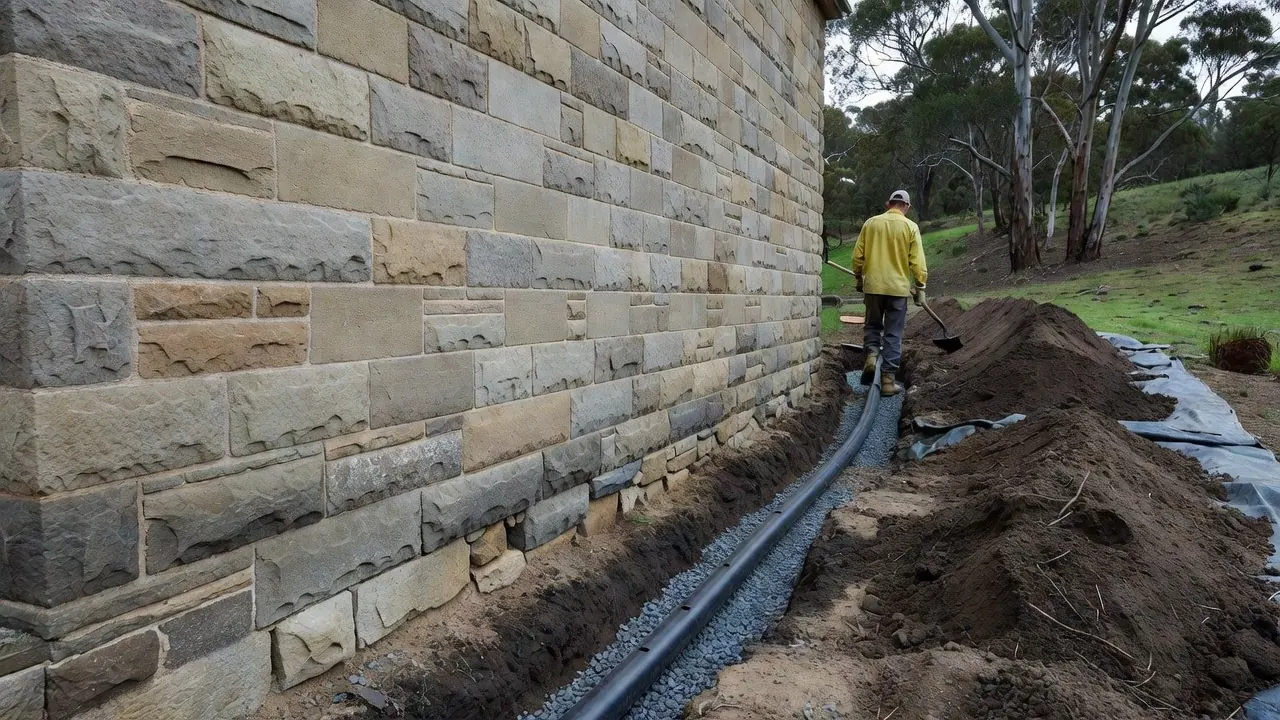
Hobart is built on hills. Where a house is cut into a slope, at least one wall has ground pressing against it above the internal floor level. If your house in South Hobart, Battery Point, Sandy Bay or the upper parts of Lenah Valley is cut into a slope, the Rising Damp Hobart assessment checks for it. It is one reason an injected damp proof course can fail to fix a wall.
| Rising damp | Lateral damp | |
|---|---|---|
| Height | Stops at a fairly level tide mark, usually under 1.2m | Can appear at any height on the affected wall, often higher |
| Which walls | Any wall in contact with the ground | Typically only the uphill wall, or the one with fill against it |
| Pattern | Gradient, wettest at the base | Often a broad damp area matching the retained earth behind it |
| After heavy rain | Slow to change | Noticeably worse within a day or two |
A waterproof membrane applied to the wall, most reliably from the outside where the ground can be excavated, or internally with a cavity drain system where it cannot.
An agricultural drain at footing level taking water away before it reaches the masonry. Usually done at the same time as tanking.
A studded membrane inside that lets water run down behind it to a drain, rather than trying to hold it back. Used where excavating outside is impossible, which on a tight Battery Point lane is often the case.
Sometimes the retained height can simply be reduced. Cheapest option by far when the site allows it.
An injected damp proof course installed near the base of a wall does nothing about water entering a metre higher through retained earth. The owner pays for the course, waits the months a wall is supposed to take to dry, and finds no improvement — by which point the original contractor is often no longer involved. That sequence is why the assessment compares external ground levels against the internal floor before any method is proposed.
We cover Hobart and the surrounding suburbs, from the Georgian cottages of Battery Point to the post-war brick of Glenorchy and Moonah.
We come out, meter the walls, look at the ground levels and tell you what is causing it. You get that in writing before we quote any repair. The visit is $450 plus GST.